
Calculus Teacher Employs Socratic Approach to Sharpen Questioning
By Ed Finkel
CTD emphasizes curiosity and exploration as essential components of talent development, based on the belief that teaching students to ask probing questions that uncover deeper answers is vital to their growth as thinkers and problem-solvers.
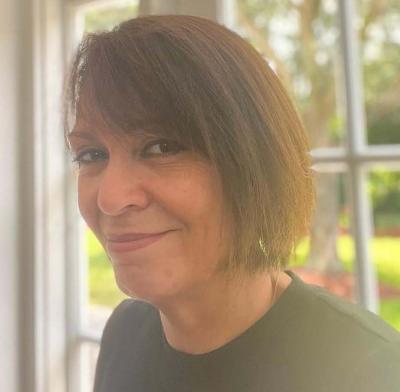
Among the many CTD instructors who embody this paradigm is Jamille Hernandez, who has been teaching AP Calculus AB while employing Socratic-style seminars in the summer program for about 15 years, and who teaches both AP Calculus BC and Post-AP Multivariate Calculus at Pine Crest School in Fort Lauderdale, Florida, during the school year.
Hernandez notes that curiosity prompts questions, which leads to information one hadn’t known, which encourages further exploration. Conversely, she says, “If you aren’t asking the questions, then you’re consuming information at face value, and that does not necessarily lead to understanding the how and the why.” In mathematics specifically, the questions are about problem-solving, in which “you need to try different perspectives and make the mistakes, so that you can then adjust your mindset and try different approaches,” she adds.
Irrespective of subject matter, teaching students simple recall of factual answers is necessary but not sufficient to scaffolding their pedagogical progress, Hernandez believes. “It’s a building block. Everyone in the class would need to have some foundational understanding of how you take a derivative, or how you take an integral,” she says. “That mechanical piece is just the foundation for solving the novel problems.”
Creative and analytical thinking skills enable students to approach problems from different perspectives, and understand how those ideas converge and can be interwoven to reach conclusions, Hernandez says. “They’re thinking creatively because they have to apply multiple ideas at the same time to solve a complex problem,” she says. “The analytical piece is the actual [exploration of], ‘What would work best in this problem?’ ”
Pivoting away from a lecture-based environment to student-to-student collaboration unlocks these discoveries, Hernandez says. “That’s when real epiphanies happen, and then they share those ideas,” she says. “That is game-changing. CTD is an excellent environment for that.”
The Socratic Approach
Socratic seminars provide students the chance to think out loud with others in a collective way about a novel, challenging problem, leading to questions that tease out insights and then pathways to otherwise unforeseen strategies, Hernandez says. “The students are positioned in the class in such a way that they can see the prompt,” she says. “Then they provide a visual of their thinking, and how they might approach solving a problem. In doing so, they’re presenting their work; they’re talking through the work.”
“I also encourage the students to be brave, and when students are brave, and then express their ideas, they become more comfortable with hearing their voice outwardly in the learning environment...” -Jamille Hernandez
An important component of Socratic seminars is valuing the insights of one person at a time, so that everyone’s voice is heard, Hernandez says. “It provides them an opportunity for great listening skills and allows them the opportunity to change their minds about how they’re thinking about a problem,” she says.
Prompting students to think out loud and present in front of the class requires establishing a culture of safety in which there’s a shared understanding that everyone makes mistakes during the learning process, and that one can’t learn solve complex mathematics problems without a willingness to do so, Hernandez says.
“I also encourage the students to be brave, and when students are brave, and then express their ideas, they become more comfortable with hearing their voice outwardly in the learning environment,” she says. “They also have the opportunity of reflecting on their participation, and then also they’re provided with some feedback and positive encouragement.”
While Hernandez doesn’t grade students on participation, she does ask that they speak up at least once during a Socratic seminar. “And that could be in the form of a question; it could be in the form of a possible solution,” she says. “It may be in the form of rephrasing something that someone else has said. And this adds a great deal of confidence, and they walk out feeling very empowered.”
Achieving Differentiation
As with any other aspect of education, teachers need to be mindful of the fact that students in a heterogeneous class need tiered assignments drawn from a thoughtful spectrum of problems—some more foundational, others with “higher ceilings” that create opportunities for those at a more advanced level to “stretch their minds” and probe deeper, Hernandez says.
“Once you do that, and you’ve provided all of the students with the groundwork, then it’s amazing how students become engaged,” she says. “And you have a bit of a mixed cooperative learning group, and they’re hearing it from their peers. And they’re getting explanations not just from the teacher, but from other students in the class. And that’s also very powerful.”
Teachers need to be ready for—and welcoming of—students’ questions or reflections that take discussions in unexpected directions, Hernandez says. “All of the time, that happens,” she says. “Because they’ve been provided an environment and a culture in the classroom where it is safe to ask questions and to share insights. … Every day, students are going to come to the class with very clever ideas. And even if that clever idea is wrong, we explore that idea, it comes to fruition in understanding concepts at a deeper level.”
Questioning Resources
Among the resources Hernandez recommends for teachers who want to build questioning skills in their classrooms is the Question Formulation Technique from the Right Question Institute, as well as the National Paideia Center at the University of South Carolina, which laid her foundation for teaching Socratic seminars. For STEM teachers specifically, she recommends “Succeeding with Inquiry in Science and Math Classrooms,” available through ASCD.
“And then, of course, there’s a plethora of resources available through inquiry-based learning searches and educational journals,” she says. “It is a game-changer in how we reach students in asking the right questions and also providing students the opportunity for them to ask the right questions in class. And the students get better at it the more they do it. That’s important, giving the students that opportunity to develop their questioning, to probe, themselves, as to the how and the why things are happening, and the what-ifs.”
Such resources only come to fruition if teachers—as they’re encouraging bravery in their students—step out of their own comfort zones, Hernandez says. “The more you try something different and give it a chance, the better it becomes, and the stronger you become as a teacher and an instructor in using these pedagogical tools in your class,” she says. “Socratic seminars, when I first started doing this many years ago, they were not successful—and I learned what it took to make them successful in the class only by actually doing it more frequently.”