
Growing Talent: How Skills, Mentorship, and Persistence Shaped a Writer’s Path
By Susan Corwith
As part of CTD’s exploration of talent development pathways, Director Susan Corwith spoke with author and educator Alysandra Dutton about how her journey unfolded—and what parents, students, and educators can learn from the pivotal experiences and skills that shaped her path.
Finding a Path to Teaching and Writing
At the Center for Talent Development (CTD), we study and document pathways—key choices, environments, and opportunities that influence educational and career trajectories. This pathway story focuses on Alysandra Dutton, an accomplished educator and writer. Dutton has taught writing in a variety of settings—including for CTD—and her new novel, The Stolen Women, is forthcoming.
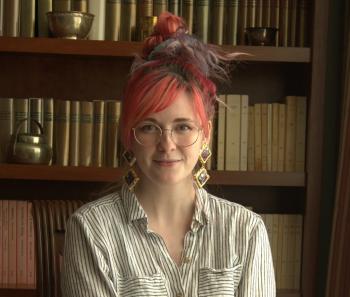
According to Dutton, CTD played a pivotal role in shaping her path. Her first experience was as an auxiliary residential assistant (RA) for the grades 4-6 summer program. At the time, Dutton was young and unsure of her educational and professional goals, but she had been a successful RA in college so a similar role and the chance to work with young students appealed to her.
That summer proved to be a turning point.
“One of the program leaders, Kate Cichon, noticed how much I naturally connected with the teaching assistants (TAs) and began involving me more in the classroom. I gradually shifted into something like an informal TA role, spending far more time in classes than in residential duties.”
Being in the classrooms—observing, assisting, and engaging with students—was a moment of clarity for her. She recalls sitting in on classes like detective science (which had a literature component), and creative writing and feeling completely energized.
“I was surrounded by incredibly creative colleagues, many with MFA degrees, who took mentorship seriously.” -Alysandra Dutton
Dutton was a writing major in college, but largely because another program she had been majoring in was cut. She was not yet considering writing as a career, nor had she imagined combining writing with teaching. That changed over the next few summers at CTD.
She returned as a teaching assistant the following year and later as a residential teaching assistant for the high school program. Eventually, Dutton became a CTD instructor, developing her own courses and mentoring TAs.
Mentors Made the Pathway Visible
While working closely with one of the CTD writing instructors, Dutton became convinced that she wanted to write and to teach. Looking back now, what stands out is how thoughtfully CTD staff placed her in writing classrooms with instructors who not only modeled strong teaching but also invited her to participate, giving her opportunities to design lessons and get meaningful feedback.
“I was surrounded by incredibly creative colleagues, many with MFA degrees, who took mentorship seriously.”
Importantly, these mentors did more than encourage her; they gave her concrete next steps. One mentor urged her to apply to MFA programs, submit her work to journals, and pursue writing with intention. That kind of practical, “insider” guidance made a decisive difference.
Although Dutton had long been interested in writing and what writers do, she didn’t initially believe she could be one. “I did not have the confidence to be a writer,” she explains. She struggled in school and did not see herself as a strong student. When she told her mom she wanted to be a writer, her mother responded thoughtfully but realistically that writing requires not just talent, but discipline. At the time, Dutton wasn’t sure she had that discipline, so she quietly set that dream aside.
Still, she continued writing for classes, aimed for good grades, and eventually began submitting work to contests. When she received a national student writing award, it marked a turning point, realizing that “maybe this is something I’m allowed to want”. Even then, the journey wasn’t linear. The external validation gave her permission to take writing seriously, but the mentorship and additional opportunities helped translate early success into sustained effort and growth.
“You have to be observant, and you have to be confident." -Alysandra Dutton
It wasn’t until much later—during the pandemic when drafting her first novel—that her identity as a writer solidified. She realized she had been a writer all along: imagining stories, building worlds, and using storytelling as a way to process and understand her experiences. In that moment, she says she saw writing differently—as something essential to who she is.
Talent Development Requires More than Content Knowledge
Content knowledge plays an important role in long-term achievement in a domain, but talent development research demonstrates that highly developed psychosocial skills are equally important. Dutton’s experience illustrates this clearly.
“You have to be observant, and you have to be confident,” she explains.
Both writing and teaching rely on noticing details an patterns: how people think, what they misunderstand, and what matters most in a moment or environment. These observations guide decisions in teaching and in writing. But observation is not enough. Confidence is required to interpret those observations, trust what you have learned, act on them meaningfully, and communicate effectively.
Without that confidence and decisiveness, it is easy to second-guess decisions or not follow through. Decisiveness informs what she focuses on. Whether teaching a lesson or writing a story, Dutton assumes her audience won’t be able to capture everything, so she must be intentional about what matters most. The question of “what’s the most important [piece]” guides both her teaching and her writing. It pushes her to prioritize clarity and purpose over trying to do or include everything.
The Identity of Teacher: Designing for Diverse Learners
With her own experience as a writer and the pedagogy she learned at CTD, Dutton has learned to prioritize learning who her students are before instruction even starts. Honing her skills in nontraditional learning environments provided space for her to be responsive and flexible, rather than utilizing a one-size-fits-all approach. Planning ahead to find out students’ levels of interest and motivation, prior experiences, and different ways of processing information is critical. This includes anticipating a wide spectrum of learning preferences and accessibility needs without expecting her students to fit into predefined categories.
This focus on responsiveness is also deeply personal. As a neurodivergent educator diagnosed with ADHD, she has come to see her way of thinking not as something separate from her teaching, but as foundational to it. Dutton says, “I’ve never not taught from a neurodivergent mind—it shapes everything I do in the classroom,” and she names this part of her identity explicitly with students, explaining how she teaches, how her mind works, and how students can advocate for clarity or pacing when they need it.
That openness has had a powerful impact. Many students, especially those who are newly understanding their own learning profiles, find this representation powerful. By modeling both self-awareness and adaptability, she embodies what inclusive teaching can look like, creating a classroom where neurodiversity is not just supported, but is visible, normalized, and valued.
Her lesson design reflects this inclusive philosophy. Each lesson is built with multiple entry points—opportunities to listen and reflect, to engage in discussion, and to practice skills directly. Dutton shares her own areas of strength and areas of struggle. She also invites students to reflect on their own learning preferences at the outset, making the classroom a more collaborative and responsive space. “When I meet a student with something new to me, it’s a chance to experiment with what works.”
The Identity of Writer: From Original Ideas to Publication
Dutton’s writing pathway reflects a similar combination of curiosity, persistence, and intentional growth. Growing up, she loved museums, music and all the fine arts. History and art showed up in her writing, and during her MFA program, she became drawn to historical fiction, in particular. That interest found sharp focus in a question that had stayed with her for years: whose stories get told and whose perspectives are left out? Historical fiction presents opportunities to imagine what might have been or could have been.
That impulse led her to write The Stolen Women, rooted in the myth of the Sabine women. But where traditional retellings often gloss over or soften the violence at the center of the story, she felt compelled to confront it directly. “I had been so angry about how this story is told—and how often the details are softened or excused.” That curiosity—and frustration—became fuel for the novel. She began conducting immersive research. She earned a fellowship that allowed her to live and study in Rome alongside historians, archaeologists, and artists. Dutton got access to archives, collections, and scholarly communities that helped transform her idea into a fully realized project.
From there, she feels lucky that the path to publication moved more quickly than expected. After going on submission, she found a publisher within months, and the process from acquisition to publication was notably fast. Behind that momentum, though, was years of disciplined revision. By the time the manuscript reached her editor, she had already reshaped it multiple times.
Looking back, Dutton notes that her journey reflects both persistence and growth, from an initial spark of curiosity to deep research, to rigorous revision, and finally to publication. At every stage, the same core skills—observation, decisiveness, and confidence—continue to guide the work.
In publishing, each milestone brings new expectations and the potential for disappointment. Having a success does not mean the rejections are behind you. Your confidence is tested regularly. This emotional reality is one of the hardest parts of a writing life, according to Dutton, and that requires resilience.
Challenge and Empowerment: Staying the Course
Dutton is grateful that she can now share her expertise and experience as a writer and teacher with her students, preparing them to embrace challenges and relish the moments that empower them. Writing and teaching have opened unexpected doors, including opportunities to travel, conduct research with experts, and engage with subjects of interest in new ways. The grants and fellowships she has received have allowed her to follow her intellectual curiosity. Her as both a writer and educator has remained a constant source of expansion and possibility.
Dutton’s story illustrates a powerful truth: talent development is not just skill-building and following a checklist. It is about recognizing your strengths and interests, making and taking advantage of opportunities, and developing the resilience, self-belief, and adaptability needed to continue toward goals—especially when the outcome is uncertain.
Alysandra Dutton is the author of The Stolen Women (Park Row HarperCollins) and an educator based in Minneapolis, Minnesota. Her work has been honored by the Elizabeth George Foundation, the Walton Family Foundation, the Bread Loaf Writer's Workshop, and the British School at Rome, where she was a member of the 2022 awards-cohort. Her stories and essays have been published in The Sun Magazine, Electric Literature: Recommended Reading, Catapult, and elsewhere. She is a teaching artist for The Loft Literary Center, Interlochen Arts Camp, Lit Cleveland, and the ALS Association, after a ten-year career at Northwestern University Center for Talent Development's summer programs, which she credits with everything she knows now about the art of educating.